Hands-only CPR
If a teen or adult collapses and is not breathing normally, call 911 and push hard and fast in the center of the chest until help takes over.
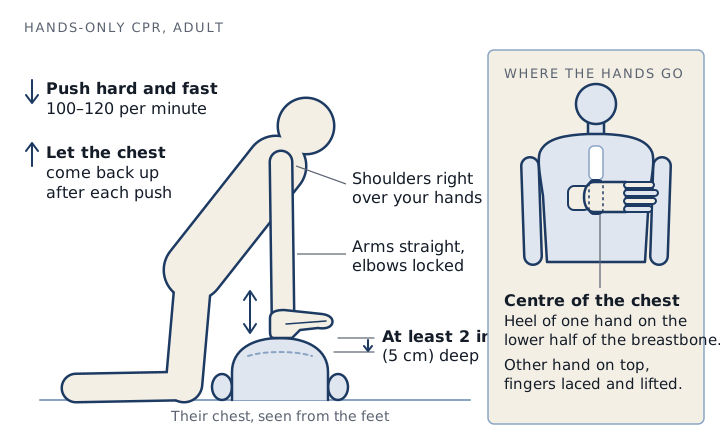
You will give chest compressions at the right speed and depth to keep blood moving until an AED or paramedics arrive.
Why it matters
More than 350,000 cardiac arrests happen outside hospitals in the US each year, and about 90% of those people do not survive (American Heart Association). Survival often depends on how quickly people nearby call 911, start CPR, and use an AED. You do not need medical training to start.
How to do it
- Check the scene is safe. Tap the person's shoulder and shout, 'Are you OK?' Look for normal breathing. Gasping is not normal breathing.
- If they do not respond and are not breathing normally, call 911 or point at someone and tell them to call. Put the phone on speaker. Send someone to get an AED.
- Make sure the person is on their back on a firm, flat surface. Kneel beside them with your knees about shoulder-width apart.
- Put the heel of one hand in the center of the chest. Put your other hand on top.
- Position your shoulders straight over your hands and lock your elbows.
- Push straight down at least 2 inches (5 cm), at 100 to 120 pushes a minute. That is about two pushes per second, the beat of the song 'Stayin' Alive'.
- Let the chest come all the way back up after each push.
- Keep going without stopping until an AED is ready, trained help takes over, or the person starts breathing normally. If someone else can help, switch about every two minutes.
- When the AED arrives, turn it on and follow its voice prompts. Keep pushing until it tells you to stand clear.
Common mistakes
- Pushing too gently or too slowly.
- Stopping often to check for breathing.
- Waiting for someone else to start.
- Placing hands too low on the belly or off to one side.
Sources
- American Heart Association - World Restart a Heart Day release (Hands-Only CPR)
- American Red Cross - Hands-only CPR
- Heart & Stroke Foundation of Canada - Learn CPR
Sources and numbers last checked . How we check
Related lessons
 5.7 · SafetyAED pad placement: how to use an AED
 5.15 · SafetyHelp a choking adult
 5.12 · SafetyThe recovery position
 5.1 · SafetyCall 911 and give your location
 5.11 · SafetyStop heavy bleeding
 1.13 · BodyHow to swaddle a newborn, and when to stop
Topics: CPR, the AED and choking, Caring for a newborn
Go deeper
 ReportThe Basic Skills Report Card 2026We graded US adults on nine basics, most of which school rarely tests, from swimming to the fine print, with Canadian data where it exists. Six subjects got an F.
 ReportWhat other countries teach that North American schools don'tFood, home, money, water safety, first aid and mental health are required lessons in several countries. Here is what they teach, from their own official documents, and what a complete curriculum would include.
 GuideCan you swim well enough to save your life?Most adults say they can swim. Far fewer say they can do the five skills that get you out of deep water. Here is the standard, the data behind it, and how to test yourself safely.
All lessons
← 5.13 previous lesson: Spot a stroke and call 911 · 5.15 → next lesson: Help a choking adult 1Body16 lessons
 1.1Washing your hands properly
 1.2Getting water out of your ear
 1.3Brushing your teeth for two minutes
 1.4Riding a bike
 1.5Getting up off the floor without your hands
 1.6Slow breathing to calm down
 1.7How to put in a tampon
 1.8How often should you wash your hair
 1.9Reading a nutrition label
 1.10Sleeping with your phone outside the bedroom
 1.11Doing 10 full push-ups
 1.12How to stretch your hip flexors
 1.13How to swaddle a newborn, and when to stop
 1.14Reading a prescription label
 1.15Booking a doctor's appointment and describing symptoms
 1.16Knowing your blood pressure
 2Mind15 lessons
 2.1Staying with boredom
 2.2Naming what you feel
 2.3Grounding yourself after a fright
 2.4Letting someone see you upset
 2.5What to wear to a funeral, where to sit, and what to say
 2.6What to write in a sympathy card
 2.7Focusing for 25 minutes
 2.8How to stop overthinking
 2.9The 988 crisis line
 2.10Changing your mind when the evidence changes
 2.11The 7 stages of grief, and why grief comes in waves instead
 2.12Telling a friend you're not okay
 2.13Knowing when stress needs professional help
 2.14Building a habit by tying it to an old one
 2.15Spending an evening alone without screens
 3People17 lessons
 3.1Introducing yourself and asking a question back
 3.2Asking a question in front of a group
 3.3Apologising properly
 3.4Disagreeing without insults
 3.5Writing a clear email, subject line to sign-off
 3.6Comforting someone who is crying
 3.7What to say to someone who lost a loved one
 3.8Saying no without an excuse
 3.9Phoning a business
 3.10How to burp a newborn
 3.11Asking for consent
 3.12Resigning from a job in writing
 3.13Answering interview questions with the STAR method
 3.14Walking into a room of strangers
 3.15How to write an obituary
 3.16Speaking up in a meeting
 3.17Pausing an argument
 4Money17 lessons
 4.1Counting back change
 4.2Comparing unit prices
 4.3Endorsing and depositing a check
 4.4How do you write a check
 4.5Setting up direct deposit with a void check
 4.6Why minimum payments cost so much
 4.7The rule of 72
 4.8What does APR mean on a credit card
 4.9Making a monthly budget
 4.10Reading a contract to find how to cancel
 4.11What is a high yield savings account
 4.12What is a contingent beneficiary, and how to name one
 4.13Filing your own tax return
 4.14How retirement accounts save you tax
 4.15Index funds and why fees matter
 4.16Ask for a raise with a number
 4.17Know how long your savings would last
 5Safety17 lessons
 5.1Call 911 and give your location
 5.2Plan two ways out in a fire
 5.3Sheltering from a tornado: watch vs. warning
 5.4The five water survival skills
 5.5Test a smoke alarm and change its battery
 5.6Cool a burn with running water
 5.7AED pad placement: how to use an AED
- 5.8Carbon monoxide detector beeping: what it means and what to do
 5.9Put out a pan fire with a lid
 5.10How is a fire extinguisher used? The PASS method
 5.11Stop heavy bleeding
 5.12The recovery position
 5.13Spot a stroke and call 911
 5.14Hands-only CPR · You are here
 5.15Help a choking adult
 5.16Respond to an opioid overdose with naloxone
 5.17When can an infant car seat face forward
 6Information16 lessons
 6.1Work out a tip in your head
 6.2Why gift card payment means scam
 6.3Wrong number text scam, and how to spot other scam texts
 6.4How to turn off location on iPhone and Android
 6.5Working out percent change
 6.6Spot a phishing message
 6.7How to block spam calls on iPhone and Android
 6.8Turn on two-factor login for email
 6.9How to check if your phone is hacked
 6.10Trace a claim before you share it
 6.11Check an AI chatbot's answer
 6.12Spot a bar chart that exaggerates
- 6.13Hang up on a 'bank' caller
 6.14What never to paste into an AI chatbot
 6.15Self-reported vs measured numbers
 6.16Relative risk vs absolute risk
 7Kitchen17 lessons
 7.1How to set a table
 7.2Cracking an egg cleanly
 7.3Following a recipe and measuring accurately
 7.4Using an oven safely
 7.5How to tell if an egg is bad
 7.6Boiling an egg to the yolk you want
 7.7How to cook rice on the stove
 7.8How long is cooked chicken good for in the fridge
 7.9Chopping an onion with the claw grip
 7.10Storing raw meat safely in the fridge
 7.11Reading food date labels
 7.12How to thaw chicken fast
 7.13How to season cast iron
 7.14Cooking chicken to a safe temperature
 7.15Five dinners you can cook from memory
 7.16Planning a week of dinners with one shopping trip
 7.17Cooking dinner for six, all ready at once
 8Home17 lessons
 8.1Making a bed with tucked corners
 8.2Removing sticker residue
 8.3Cleaning a toilet properly
 8.4How to clean a shower
 8.5How to get blood out of clothes
 8.6Laundry symbols: how to read a care label
 8.7Doing a load of laundry
 8.8Cleaners you must never mix
 8.9How to get rid of fruit flies
 8.10Unblocking a toilet with a plunger
 8.11Resetting a tripped breaker
 8.12Building a 72-hour emergency kit
 8.13Shutting off the water
 8.14Reading a utility bill
 8.15How to clean a dryer vent
 8.16Recording a rental's condition on move-in day
 8.17Splitting chores with a housemate
 9Hands18 lessons
 9.1Tying shoelaces that stay tied
 9.2How to wrap a present
 9.3Addressing an envelope
 9.4Tying a square knot (reef knot)
 9.5How to tie a clove hitch
 9.6Reading a tape measure
 9.7Hammering a nail in straight
 9.8How to fix a separated zipper
 9.9Sewing on a button that stays on
 9.10Tying a bowline
 9.11How to remove a stripped screw
 9.12Hanging a heavy picture securely
 9.13Tying a four-in-hand necktie knot
 9.14How to put air in tires
 9.15How to change windshield wipers
 9.16Checking the oil and other fluids under the hood
 9.17Assembling flat-pack furniture
 9.18Changing a flat tire
General education, not medical, legal or financial advice.
From undertaught.com/manual/hands-only-cpr. Free, sourced lessons for every skill at undertaught.com/manual.